
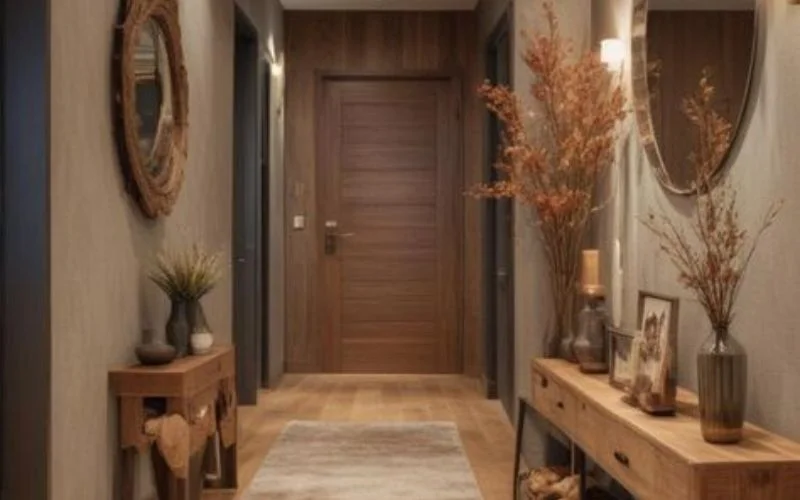
Narrow hallway spaces can feel wider without changing the floor plan. The biggest improvements usually come from reducing visual clutter, keeping walking space open, improving lighting, and choosing furnishings with shallow profiles. Small changes work because hallways are experienced as one long sightline, so every obstruction becomes more noticeable than it would in a larger room.
Keep the Walking Line Visually Clean
A hallway feels narrower when furniture, baskets, shoes, decorative objects, and wall features repeatedly interrupt its edges. Start by identifying what genuinely needs to stay in the space.
People gathering home design inspiration may be tempted to add more decorative pieces, but narrow halls often benefit from restraint. One intentional focal point can create more character than several unrelated accessories.
Choose Shallow Furniture Carefully
A slim console can work where circulation space allows, particularly in a wider entry section. Deep cabinets or freestanding shelving can quickly make the same hallway uncomfortable.
Measure the usable passage before buying anything. The prettiest console is a poor choice if everyone has to turn sideways to pass it.
Use Light to Remove Dark Visual Boundaries
Dark corners can make a corridor feel tighter because the eye cannot easily read its full dimensions. Even lighting helps maintain a more continuous sense of space.
Browsing interior and lifestyle stories can provide decorative inspiration, but lighting placement matters as much as fixture style. A beautiful fixture that leaves long stretches of the hall dim may do little to improve the perceived width.
Wall sconces can work in some layouts, although protruding fixtures should not interfere with movement.
| Design Problem | Smarter Choice | Visual Effect |
|---|---|---|
| Dark corridor | Even layered lighting | Makes edges easier to see |
| Bulky storage | Shallow closed storage | Preserves walking room |
| Busy walls | Fewer larger pieces | Reduces visual clutter |
| Broken sightline | Consistent finishes | Makes hallway feel connected |
Make the Walls Work Harder
Wall treatment can influence perceived proportion without occupying floor space. A consistent light or mid-tone finish often creates a calmer visual field, though a darker scheme can also work when lighting is strong and the design is intentional.
Ideas found through decorating and story content may encourage gallery walls, mirrors, molding, or contrasting paint. In a narrow corridor, choose one dominant idea rather than combining every treatment.
A well-positioned mirror can reflect light and surrounding space, but several small mirrors may create more visual fragmentation than width.
Where Hallway Decorating Goes Wrong
Trying to make a narrow hallway interesting by filling every empty wall is a common mistake. More décor does not automatically create more personality. In a confined passage, excess frames, hooks, shelves, baskets, signs, and accent pieces can compete for attention.
Another problem is using undersized artwork repeatedly. A stronger piece or a disciplined group can create a cleaner focal point while letting more wall remain visually quiet.
Create a Longer, More Continuous Sightline
Flooring can influence whether the eye experiences a hallway as one connected space or a collection of small segments. Consistent flooring extending into adjoining areas often makes the transition feel smoother.
Runners can add comfort and pattern, but size matters. A rug that bunches, slides, or nearly touches both walls can make circulation awkward.
At the far end of the hallway, consider one visual destination: artwork, a carefully chosen light fixture, a plant where conditions permit, or an architectural feature. Drawing attention forward can shift emphasis away from the narrow side walls.
Frequently Asked Questions
What colors make a narrow hallway look wider?
Light colors can reflect available light and make boundaries feel less dominant, but color alone will not solve poor lighting or clutter. A consistent palette combined with good illumination generally has a stronger effect.
Should I put a console table in a narrow hallway?
Only if enough passage width remains after installation. Shallow furniture can add storage or create a focal point, but preserving comfortable movement should take priority over adding another decorative surface.
Do mirrors make narrow hallways look larger?
Mirrors can reflect light and nearby space, which may reduce the enclosed feeling. Placement matters, though. One appropriately sized mirror often creates a cleaner effect than many small reflective pieces.
Design for Movement First
The best narrow hallway design begins with the reason the space exists: movement between rooms. Clear the walking path, improve illumination, simplify the walls, and then add only the furniture or décor that earns its place. Creating width is often less about adding design features and more about removing the visual interruptions that make the corridor feel compressed.




Leave a Reply